The department of Electronics and Telecommunication Engineering (E & TC) was established in the year 1984. This is one of the major departments in the institute, offering two programs which are B Tech (Electronics and Telecommunication) and M Tech (VLSI and Embedded System) with the intake of 120 and 6 respectively. The department also offers Ph. D program. The aim of the department is to provide technical education of the highest standard. The department has always been on a high growth path to keep pace with the ever-increasing importance of the major discipline of study as current technology trends.
The term Electronics and Telecommunication engineering denotes a broad engineering field that covers important subfields such as Analog Electronics, Digital Electronics, Consumer Electronics, Embedded Systems, VLSI Design, Power Electronics, Communication Systems. Electronics-based products play a vital role in our daily lives, from the sophisticated diagnostic equipment used in modern hospitals to leading-edge fibre optic communications. Computer Technology, Telecommunications and Consumer Electronics are advancing at an ever-increasing pace. We offer degree courses teaching state of the art technology, allowing our graduates to work at the forefront of all the major areas of Electronics and Telecommunication engineering.
The department has experienced staff members who are serving the college from last 20 to 30 years. The department has excellent state of the art laboratory setup. It also operates and maintains an Audio-Video hall of capacity 150 and equipped with 200 audio video courses from IITs. The department also has a PCB lab and large number of software tools for students to use.
The faculty is actively participating in various conferences, workshops, seminars, training programs at national and international level. They also present technical papers at national and international conferences frequently, which are also published in reputed journals. DST, Pune University and AICTE have funded the research proposals filed by the department faculty. Sincere and dedicated efforts of our students and staff have transformed into excellent results with University toppers, which has put the department at the forefront in the Pune University. Apart from academic excellence, the department also encourages students to take part in various co-curricular activities.
Our students have received prizes at different national and international competitions. To name the few, Team Matrix, has been selected for the finals of the ISRO Robotics Challenge 2025, Obtained 7th place in ISRO Robotics Challenge 2024, 2nd rank in National Robotex Challenge 2024. Secured First prize in ABB Live Project competition 2024, Secured First prize “RIT Hackathon-2024” organized by RIT, Sangli, First prize in "Tech Fiesta International Hackathon-2024" organized by PICT, Pune. Achieved 2nd world Rank at Technitude International Hackathon organized by S P Jain school of Management, Sydney.
Department also provides guidance related to IPR. Students are encouraged to publish their final year project results. Many students have filed patents under guidance of department faculty members and IPR coordinator. SAEE, Student’s Association of Electronics Engineering, organizes many expert lectures and workshops for students. This organization provides a platform for students to develop organizational skills and to upgrade their technical competence.
The department conducts a National level Technical Symposium 'Telekinesis' annually for the benefit of the students. The students are taken to industrial visits and experts from industries are invited to interact with students regularly to bridge the gap between theory and practice. Many UG students undergo vocational training in industries like Siemens, BOSCH, HAL and BSNL. Workshops on preparation for aptitude tests and interviews for placement in MNCs are conducted for final year students. The students passed out in past two decades from this department have been successfully placed in various private sectors and public sector organizations. TCS, Infosys, Capgemini, Siemens, KPIT, L & T Infotech, Rishabh Instruments, Mahindra and Mahindra, CGL, PSPL, Persistent Systems, Perennial Systems, Fin IQ, TietoEvry, Emerson and BOSCH are our regular recruiters. The department also encourages the students to be entrepreneurs. The department is having very fruitful industry and alumni connect.
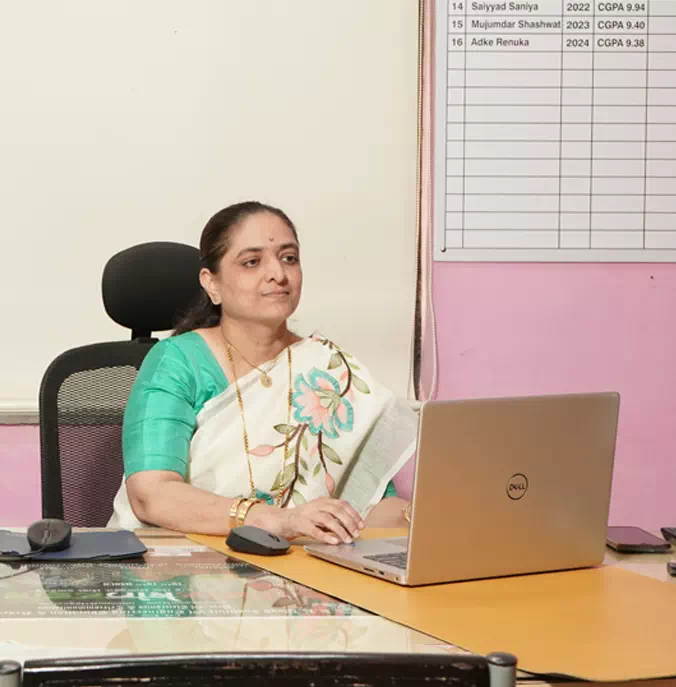
Prof. Dr. Sunita A Patil (Wagh)Head of E&TC Department
Constitution of Board of Studies (BoS)
A Board of Studies (BoS) members help in shaping curriculum and ensuring quality education. The BoS is responsible for reviewing the syllabi for various courses, ensuring they align with the institution's objectives. It supports by recommending textbooks, and suggesting teaching and evaluation methods. The BoS also proposes panels of examiners and advises on academic matters related to specific subjects. Thus, the BoS acts as a bridge between academic theory and practical application, ensuring that the curriculum is relevant, up-to-date, and effectively delivered to students.
Board of Studies (BoS) Members
Sr.No.
Name
Designation
1
Prof. Dr. Shrinivas Mahajan, Professor, COEP Technological University, Pune.
Subject Expert, BOS
2.
Prof. Dr.Nilkanth Chopade, Deputy Director, PCCOE, Pune
Subject Expert, BOS
3
Mr. Shirish Chaphekar, Director, Emerson export Ltd.
Industry Expert, BOS.
4
Mr. Parag Dharmadhikari, Design Engineer , General Electric, Germany
Alumni Representative , BOS
5
Prof. Dr. Preeti Rao, Professor, IIT Bombay
Member (VC Nominee)
6
Prof. Dr. S. A .Patil
Chairman, BOS
7
All Staff members
Internal Member, BOS
Department Advisory Board (DAB)
Roles and responsibilities of Department Advisory Board:
Department Advisory Board is panel of industry experts, academicians, alumni, and government or research institution representatives who advise the E&TC department on how to keep the program aligned with current industry standards and technological advancements.
Department Advisory Board is formed to accomplish the Vision, Mission of institute and department.
Curriculum Enhancement: Provide expert advice to keep the curriculum relevant by incorporating emerging technologies, practical skills, and industry standards.
Industry Collaboration: Facilitate partnerships for internships, live projects, guest lectures, and workshops to enhance students’ practical exposure.
Research Guidance: Suggest focus areas for research and development aligned with industry demands and technological advancements.
Quality Assurance: Help establish quality benchmarks and evaluate the department’s performance in academics, research, and student outcomes.
Placement Support: Guide the department on enhancing student employability, soft skills, and certifications needed for better placement opportunities.
Infrastructure Recommendations: Advise on upgrading laboratory facilities, tools, and equipment to meet current industrial practices.
Department Advisory Board also monitors the academic performance of the program.
Department Advisory Board (DAB) Members (External)
Sr.No.
Advisory Board Members
Designation
1
Prof. Dr. D. S. Bormane (Academician)
Principal AISSM CoE Pune, and Chairman BoS E&TC, Savitribai Phule Pune University.
2
Dr. Swati Shilaskar (Academician)
Dean, Student Career Counselling & Guidance, Vishwakarma Institute of Technology, Pune
3
Dr. Shrikant S. Joshi (Academician)
Assistant professor E&TC, VIIT, Pune
4
Mr. Ganesh Baviskar (Industry )
Deputy General Manager, CG Power & Industrial Solutions Limited, Nashik
5
Mr. Nikhil Jain (Industry & Alumni)
Chief Manager-Engineering Siemens Ltd., Nashik
6
Er.Ashish Mhaske (Alumni)
Scientific & Technical officer, IUCAA, Pune.
7
Ms. Shrisha Sudhir (Industry & Alumni)
Software Engineer at Birla soft Solutions, Bangalore
8
Mr. Jayesh Vyawahare (Industry & Alumni)
System Engg., Emerson Export Engineering Centre, Nashik
9
Mr. Chaitnya Kulkarni (Student)
Student, KKWIEER, Nashik
10
Mr. Yash Giri (Student)
Student, KKWIEER, Nashik
11
Mr. Atharav Mayekar (Student)
Student, KKWIEER, Nashik
12
Ms. Tanishka Lakde (Student)
Student, KKWIEER, Nashik
13
Ms. Vaishnavi Desale (Student)
Student, KKWIEER, Nashik
14
Ms. Snehal Khalkar (Student)
Student, KKWIEER, Nashik
Innovative Teaching Learning Techniques
Simulation tools revolutionize teaching by creating immersive learning experiences. These tools allow students to actively engage with complex concepts in a safe, controlled environment. By replicating real-world scenarios, simulations foster critical thinking, problem-solving skills, and decision-making abilities. Students can experiment with different approaches, learn from their mistakes, and develop a deeper understanding of the subject matter. This interactive approach enhances motivation and retention, making learning more enjoyable and effective. Simulation tools are particularly valuable in fields where hands-on experience is crucial for professional development. Different simulation tools are used by faculty like Falstad, circuitverse ,Keil software,CISCO packet tracer,EMANIM,Xilinx and Microwind etc
The potential of the internet self-learning mode is considered to be very high. Therefore, the institute provides internet facility in both the academic and hostel campuses for 24 x 7. The availability of internet facility allows them to learn and to gather the information from worldwide network without any interruptions. To further enhance self-learning, learning material created by faculty is also made available through Udemy courses, Blogs, Google classrooms and Youtube Channels.
An LMS is a software application or web-based platform designed to facilitate the administration, documentation, tracking, and delivery of educational courses or training programs. It provides a centralized and automated way for organizations, educational institutions, or businesses to manage and deliver learning content to their learner’s .It is used for Creating, organizing, and managing courses and learning materials. Monitoring and recording learner progress. Creating and grading quizzes to evaluate learner understanding. Facilitating communication between instructors and learners, and sometimes among learners themselves. Various types of content such as videos, presentations etc are shared with students.
Learnico
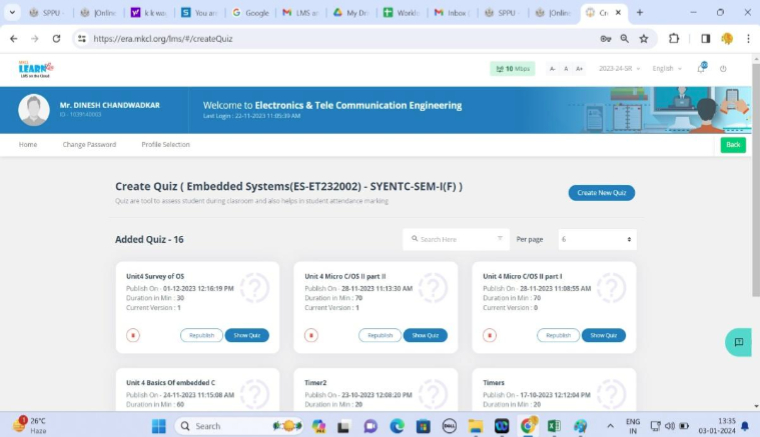
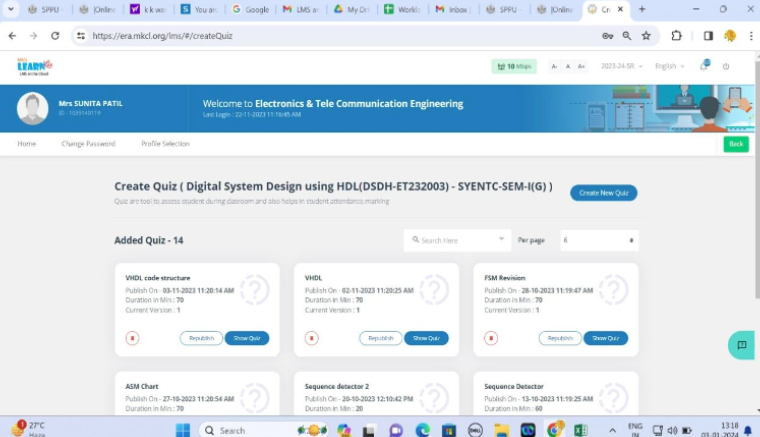
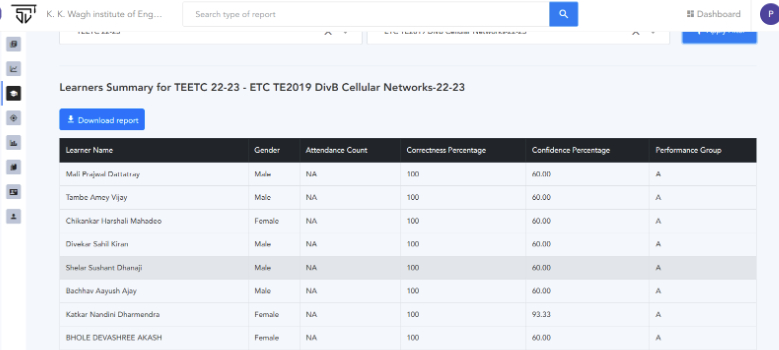
MKCL learnico platform is ued to conduct quiz. It also shows students attentiveness during the lecture and understanding of topic.
Quizzes are conducted through LMS LearnLive. Table shows List of quizzes conducted through LMS for various subjects.
Table List of quiz conducted troughs LMS
Name of Subject
Class
Name of Teacher
No of Quizzes Conducted through LMS
AY 2024-25 SEM-I
Electronic Devices and Circuits
SY (E&TC)
Dr. S. P. Munot
9
Digital System Design using HDL
SY (E&TC)
K. Nirmalakumari
29
MDM
SY (E&TC)
Shweta Wankhdede
5
OE-1 (Industrial Management)
SY (E&TC)
N. M. Bhujbal
2
Electronic Devices and Circuits
SY (E&TC)
R. V. Chothe
9
Digital System Design using HDL
SY (E&TC)
Dr. D. M. Chandwadkar
5
MDM
SY (E&TC)
Dr. A. A. Gupta
5
OE-1 (Industrial Management)
SY (E&TC)
N. M. Bhujbal
2
Problem Solving using Python
SY (E&TC)
M. V. Marhate
6
Electromagnetic Engineering
TY (E&TC)
S. D. Raut
38
Cellular Network
TY (E&TC)
Dr. S. Srivastava
5
Problem Solving using Python
TY (E&TC)
P. S. Jadhav
5
Elective -1 Interfacing Techniques
TY (E&TC)
Dr. S. S. Morade
5
Elective -1 Foundation course in ML
TY (E&TC)
Dr. S. S. Morade
8
Internet of Things
TY (E&TC)
R. V. Daund
28
Electromagnetic Engineering
TY (E&TC)
S. V. Shelke
34
Cellular Network
TY (E&TC)
Dr. S. Srivastava
5
Problem Solving using Python
TY (E&TC)
M. V. Marhate
23
Elective -1 Interfacing Techniques
TY (E&TC)
Dr. S. S. Morade
5
Elective -1 Foundation course in ML
TY (E&TC)
N. A. Dheringe
22
Internet of Things
TY (E&TC)
R. V. Daund
26
276
AY 2023-24
Digital Signal Processing
SY (BTech)
Dr. S. P. Munot
10
Communication Engineering
SY (BTech)
P. P. Patil, S. R. Wankhede
12
VLSI Design and Technology
SY (BTech)
K. Nirmalakumari
10
Control Systems
SY (BTech)
S. D. Raut
23
Industrial Management
SY (BTech)
N. M. Bhujbal
10
Communication Engineering
SY (BTech)
P. P. Patil
6
VLSI Design and Technology
SY (BTech)
K. Nirmalakumari
14
Control Systems
SY (BTech)
S. D. Raut
23
Industrial Management
SY (BTech)
N. M. Bhujbal
10
Project Management
TE
P. J. Mondhe
6
Elective -2 Advanced JAVA
TE
M. V. Marathe
9
Elective -2 Network Security
TE
R. V. Chothe
1
Cellular Networks
TE
S. V. Shelke
4
Project Management
TE
P. J. Mondhe
6
Elective -2 Advanced JAVA
TE
M. V. Marathe
9
Fiber Optic Communication
BE
Prof. Dr. S. A. Patil
1
Embedded Systems
SY
Dr. D. M. Chandwadkar
16
Digital System Design
SY
Dr. S. A. Patil
14
Electronics Circuits
SY
R. V. Chothe
13
M-III
SY
D. A. Kokande
8
Embedded Systems
SY
Dr. S. S. Morade
16
Digital System Design
SY
Dr. D. M. Chandwadkar
14
Electronics Circuits
SY
R. V. Chothe
13
Database Management Systems
TE
P. J. Mondhe
6
Microcontroller
TE
Dr. S. S. Morade
3
EMT
TE
S. V. Shelke
9
Radiation and Microwave Theory
BE
P. P. Patil
4
270
AY 2022-23
Principles of Communication System
SE
D. C. Shimpi
4
Signals and Systems
SE
Dr. S.S. Morade
6
Object Oriented Programming
SE
P. J. Mondhe
9
Project Management
TE
N. M. Bhujbal
3
Elective - 2: Network Security
TE
R. V. Chothe
4
Cellular Networks
TE
S. V. Shelke
9
Elective - 2: Network Security
TE
R. V. Chothe
4
Elective - 5: Mobile Computing
BE
R. R. Khinde
2
Digital Circuits
SE
K. Nirmala Kumari
4
Electrical Circuits
SE
S. R. Baji
14
Data Structure
SE
S. Shevgekar
6
Digital Circuits
SE
Prof. S. V. Shelke
5
Electronics Circuits
SE
R. V. Chothe
4
Data Structure
SE
P. J. Mondhe
5
Database Management Systems
TE
P. J. Mondhe
5
Digital Communication
TE
D. C. Shimpi
2
Electromagnetic
TE
S. D. Raut
4
Microcontroller
TE
Dr. S. S. Morade
5
Fundamentals of Java
TE
S. Badgujar
2
Computer Network
TE
R. V. Chothe
7
Database Management Systems
TE
K. S. Navale
1
Digital Communication
TE
P. P. Patil
4
Electromagnetic
TE
S. V. Shelke
4
Microcontroller
TE
Dr. D. M. Chandwadkar
5
VLSI
BE
Dr. S. A. Patil
6
Radiation And Microwave Theory
BE
P. P. Patil
10
Cloud Computing
BE
M. P. Joshi
5
Java Script
BE
Sejal Badgujar
1
PLC
BE
Dr. K. S. Holkar
5
EPD
BE
R. R. Khinde
5
351
Total Quizzes Conducted
897
Online Courses
The National Mission on Education through Information and Communication Technology (NMEICT) has been envisaged as a Centrally Sponsored Scheme to leverage the potential of ICT, in teaching and learning process for the benefit of all the learners in Higher Education Institutions in “any time anywhere” mode
Dr. S. A. Patil (Ugale) developed an online course “Optical Communication” under the project named “National Mission Project on Education through ICT”, hosted by IIT, Kharagpur, which is freely available online for students.
Under NME-ICT through MHRD various courses are developed and certification is available for free on Spoken Tutorial. Students are encouraged to enroll for these courses to gain knowledge and get certification.


 Chat
Now
Chat
Now