Entering the Era of Wearable Electronics
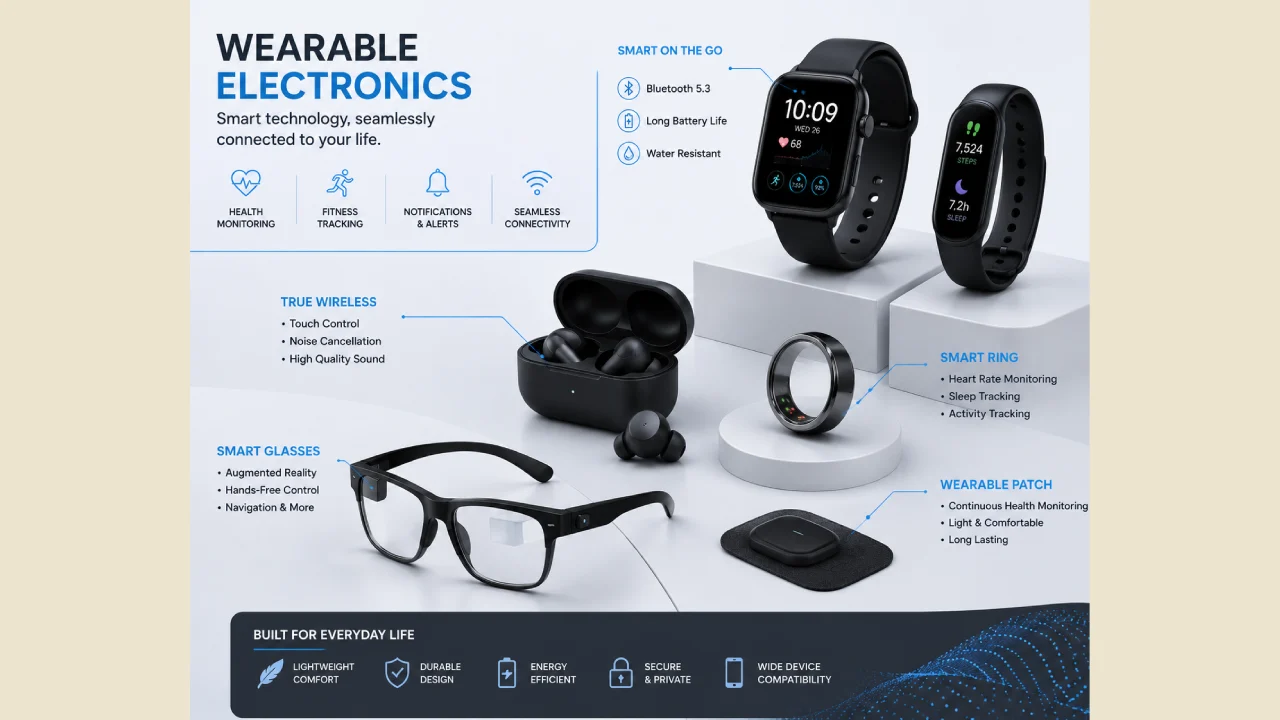
Today, our clothes are no longer merely a matter of fashion—they have begun to communicate. Wearable technology—which encompasses sensors, wireless connectivity, and electronics seamlessly integrated into clothing—is clearly on the rise. In India, this industry is witnessing immense opportunities, ranging from health monitoring embedded in garments to stylish fashion pieces and fully integrated smart jackets. This "smart revolution" is opening new doors for everyone—from rural communities to urban centres, and for women and students alike—creating a powerful convergence of product innovation, business growth, and lifestyle transformation.
Wearable electronics is a cutting-edge branch of technology focused on developing electronic devices designed to be worn directly on the body. These devices are characterized by their flexibility, lightweight nature, and the inclusion of various sensors, allowing them to remain fully synchronized with the body's movements.
AI-powered hearing aids, and devices such as Meta Quest and Microsoft's HoloLens—a holographic computer in the form of a virtual reality headset are the most advanced examples of wearable electronics technology. Another example of wearable technology is a disposable skin patch equipped with sensors, which wirelessly transmits patient data to monitoring systems within a healthcare facility.
Globally, the demand for products related to health, fitness, and lifestyle has surged. Thanks to sensors and connected technologies, it has become possible to continuously monitor an individual's health over time.
According to certain reports, the Asia-Pacific region—including India—ranks among the leaders in the wearable technology market.
Technological advancements, affordable devices, and the growing utilization of data-driven services serve as the primary drivers behind this trend. Furthermore, the scope of wearables has expanded beyond mere fitness applications to encompass features such as payment processing, smart home control, and smart textiles.
How does wearable technology work?
Modern wearable technology encompasses a wide spectrum of applications, including smartwatches, smart jewellery, web-enabled eyewear, fitness trackers (such as the Fitbit Charge), VR headsets and Bluetooth devices. Wearables function in different ways depending on their intended purpose—whether it be for health monitoring, fitness tracking, or entertainment. Most wearable devices are equipped with microcontroller, batteries, and internet connectivity, enabling the collected data to be synchronized with other electronic devices, such as smartphones or laptops.
Wearables includes embedded sensors used to track physical activity, it provides biometric identification, and also assist with location tracking. For instance, activity trackers or smartwatches—the most common types of wearables—typically consist of a wristband worn around the user's wrist to monitor their physical movements and vital signs throughout the day.
Most of the wearable devices are either worn directly on the body or attached to clothing, while some are designed to function without requiring any physical contact with the user. For example Cell phones, smart tags, or computers not worn but are carried by user and still they track a user's movements. They utilize remote smart sensors and accelerometers to track movement and speed, while some employ optical sensors to measure heart rate or glucose levels. A common element among these wearables is that they all monitor data in real time.
What are the applications of wearable technology?
Consumer electronics—such as smartwatches and fitness trackers—represent the primary use of wearable technology. Due to recent advancements in the Internet of Things (IoT) and AI, wearable technology is now being deployed across a wide variety of environments—including healthcare devices, navigation systems, consumer goods, professional sports, and advanced textiles.
Wearable technology offers numerous applications, including health and fitness tracking, chronic disease management, interactive gaming, performance monitoring, and navigation.
Applications of wearable technology:
- Health monitoring: People utilize wearable technology to track their heart rate and blood pressure, receive notifications, monitor their calorie intake, or manage their training regimens. The use of wearable technology surged during the COVID-19 pandemic as consumers gained heightened awareness regarding personal hygiene and adopted precautionary measures to curb the spread of infection. Cardiogram updated its watchOS app by introducing a new "Sleeping Beats Per Minute" feature designed to monitor heart rate fluctuations in COVID-19 patients.
- Entertainment and Gaming: The gaming and entertainment industries have adopted VR headsets, smart glasses, and controllers. Popular VR head-mounted displays—such as Meta Quest and Sony PlayStation VR—are used for all forms of entertainment, including gaming, watching movies, and virtual travel.
- Epidermal Skin Technology: According to "Science Daily", the Terasaki Institute for Biomedical Innovation has developed a wearable "electronic skin" designed for health monitoring. Representing the next generation of wearables, this ultra-thin e-patch—paired with a small wireless transmitter—can be attached to the wearer's chest area using a water spray and worn for up to a week. It is sensitive enough to detect and record electrical signals within the body—such as heartbeats and muscle movements—which can then be transmitted via the cloud to healthcare providers, enabling them to remotely monitor the user's vital signs. These powerful wearable addresses chronic diseases such as heart disease and diabetes furthermore, there is a measure in place to monitor catastrophic events such as heart attacks.
- Fashion and Smart Clothing: Garments known as "smart clothing" or "intelligent fashion" have gained popularity over the last few years. A smart jacket allows the wearer to activate their mobile device—by simply touching a sensor on their sleeve—to answer calls, play music, or take photos. Smartwatches, wristbands, smart shoes, and smart jewelry such as the Oura Ring are other popular examples of wearable technology.
- Innovation in E–Textiles E-Jacket: It is a system that works as a wearable/smart cloth. Through which the safety of women can be increased. This project is very useful in terms of women empowerment, rural education and technology
- Diabot Project (In-Shoe Wearable Sensor): In many countries including India, the incidence of diabetes is increasing and foot ulcers are a major health problem. Devices like DiaBot detect these problems quickly. In rural and remote areas where doctors/medical facilities are scarce, such a device can facilitate step-by-step health monitoring
- Military: This wearable architecture includes vital sign tracking technology very useful for the soldiers deployed in remote locations with heavy weather conditions.
Wearable electronics is not just about gadgets. It is the confluence of lifestyle, health technology and social change. This is a big deal for India, especially towards rural and women empowerment. But along with this, it is important to take into account the competition, customer expectations and technical challenges
This exciting world of wearable electronics can be explored in the engineering courses like Electronics, Electronics and Telecommunication, and Mechatronics. At K. K. Wagh Institute of Engineering Education & Research, Nashik , the Electronics and Telecommunication department can introduce you to a totally new and exciting world of Wearable Electronics where there are plenty of opportunities in future.

Dr. Sunita Aniruddha Patil
Professor and Head, Department of Electronics & Telecommunication Engineering

Recent Post
- From K. K. Wagh to Japan: An Electrical Engineering Student’s Career Journey
- Top In-demand Engineering Courses in Maharashtra - Fees, Details, and Admission 2026
- Industry-Oriented Engineering Education: The Key to Career Success in 2026
- Why an M.Tech in VLSI & Embedded Systems Is One of the Smartest Career Choices in 2026
- Unleashing Student Potential Through Sports
- Where Ideas Take Shape: Inside the Engineering Workshop at KKWIEER
- Elevate Your Career: Postgraduate & Ph.D. Programmes at K. K. Wagh Institute of Engineering Education & Research (KKWIEER)
- Innovations at K K Wagh Institute of Engineering
- Entering the Era of Wearable Electronics
- NEP and Autonomy Implementation at KKWIEER
- B. Tech in Electronics & Telecommunication - Course, Syllabus, Eligibility & Scope
- Direct Second Year (DSE) Engineering Admission: Complete DSE Guide
- Are you an aspiring Engineer from Maharashtra State? Complete FY B.Tech/B.E. Guide
- Fueling Passion: Inside Our Automotive Club Journey
- International Collaborations at K K Wagh Institute of Engineering Education & Research, Nashik
- Health care facilities at K K Wagh Institute of Engineering Education & Research Nasik
- Engineering education in India: Reflections and Insights
- Celebrating Academic Excellence at K. K. Wagh
- Career Assistance at K K Wagh


 Chat
Now
Chat
Now